


How do I lessen my social anxiety? Ask TikTok, a family member, or a stranger, and you’ll probably get a lot of different answers, such as: “Try manifesting social confidence;” “Just stop thinking about it;” or “Have you heard of this course to overcome social anxiety?”
How can you tell which approach will actually work? It’s extremely difficult to tell with so many options thrown your way. Fortunately, learning warning signs that a treatment may not be evidence-based is a great place to start
What Does Evidence-Based Actually Mean?
An evidence-based treatment simply means that a treatment has been shown, consistently time and time again, to be effective by generating positive outcome data in research. It is a mental health professional’s job to understand the new research coming out every year and to select treatments with the best evidence to help their clients. However, without reading research papers, diving into statistical models, and getting a graduate degree in a mental health field, you can still spot treatment approaches that are likely not evidence-based by learning their red flags.
Red Flags: How to Spot the Hype
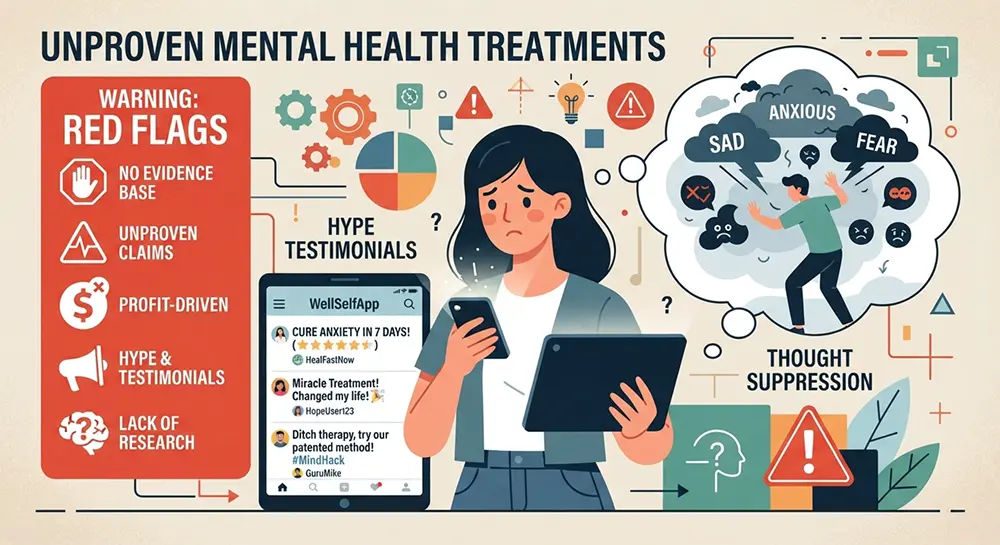
The red flags below are adapted from Lilienfeld et al (2015, pp 7-10).
Where’s the Research?
One clear sign that a treatment is evidence-based is if the treatment has been a part of a research study, or preferably, lots and lots of research studies. Research studies for mental health treatments, such as treating social anxiety, involve administering the treatment to lots of people and recording the results.
Ideally, these research studies are Randomized Controlled Trials (RCTs). RCTs are research studies where participants are randomly selected to receive either the active treatment or an inactive treatment (placebo). RCTs are considered the “gold standard” for research in healthcare overall, whether it’s a study on psychotherapies or prescription drugs.
Forgetting the Placebo Effect
A key part of RCTs is accounting for the placebo effect—when people experience improvement in physical or mental health symptoms simply by believing they will get better or due to random external factors.
Researchers account for this by separating participants into two groups: one group receives the active treatment being tested, while the other receives an inactive placebo (such as a sugar pill or control intervention). Researchers then measure whether the group receiving the true treatment performs significantly better than the placebo group. Without this accounting, every new intervention will have some participants report improvement regardless of whether the intervention itself worked.
Skipping Expert Scrutiny
Another essential piece of the scientific process is peer review. Researchers across fields like psychology, medicine, and chemistry submit their findings to independent experts who scrutinize the research design, statistical analyses, and conclusions to ensure quality, accuracy, and originality. Approaches that avoid peer-reviewed journals and independent expert feedback represent a major red flag.
Testimonials Are Not Science
When non-evidence-based treatments lack empirical support, they often rely heavily on individual testimonials as their primary proof of efficacy. Testimonials fail to measure how many individuals did not benefit, experienced adverse side effects, or dropped out.
“Prove Me Wrong” Logic
In scientific research, the burden of proof rests on the person making a claim. A common red flag in non-evidence-based approaches is a reversed burden of proof, where promoters claim their intervention works until someone else proves it doesn’t.
Examples of Interventions with Red Flags
Social Coaches & Pick-Up Artists often promise rapid results for public speaking, dating, or confidence building using self-published courses or unreviewed data, relying heavily on testimonials while avoiding rigorous clinical trial testing.
Manifestation & Law of Attraction: Claims that emitting specific mental “frequencies” or positive intentions alone will alleviate social anxiety lack empirical peer-reviewed support and misplace the burden of proof.
Thought Stopping: This is an example of an intervention that did undergo scientific study, only for research to show it is ineffective. In fact, deliberately suppressing anxious thoughts often produces a rebound effect, making those thoughts stronger (Abramowitz et al., 2001).
What Treatment Is Evidence-Based and Effective?

Since specific social anxiety outcome studies began in the 80s, the most effective evidence-based treatments to address social anxiety disorder are cognitive-behavioral therapy (CBT), and secondarily certain medications prescribed by medical professionals (Hall et al., 2025; Mayo-Wilson et al., 2014).
Cognitive-behavioral therapy (CBT) for social anxiety disorder (also known as social phobia) has been researched for decades across hundreds of peer-reviewed studies. This large body of evidence demonstrates that CBT produces lasting, statistically significant improvements even after controlling for placebo effects. To learn more about evidence-based CBT protocols, visit this section of the National Social Anxiety Center website.
[Edited by: Paul DePompo PsyD, ABPP, NSAC Blog Coordinator.]References:
Abramowitz JS, Tolin DF & Street GP. (2001). Paradoxical effects of thought suppression: A meta-analysis of controlled studies. Clinical Psychology Review, 21 (5), 683-703.
Hall M, Luo A, Bhullar N, Moses K & Wootton BM. (2025). Cognitive behaviour therapy for social anxiety disorder: a systematic review and meta-analysis investigating different treatment formats. Australian Psychologist, 60 (1), 1-14.
Lilienfeld SO, Lynn SJ & Lohr JM. (2015). Science and pseudoscience in clinical psychology: Initial thoughts, reflections, and considerations. In SO Lilienfeld, SJ Lynn & JM Lohr (Eds.), Science and pseudoscience in clinical psychology (2nd ed., 1-16). Guilford Press.
Mayo-Wilson E, Dias S, Mavranezouli I, Kew K, Clark DM, Ades AE & Pilling S. (2014). Psychological and pharmacological interventions for social anxiety disorder in adults: a systematic review and network meta-analysis. The Lancet Psychiatry, 1 (5), 368-376.