
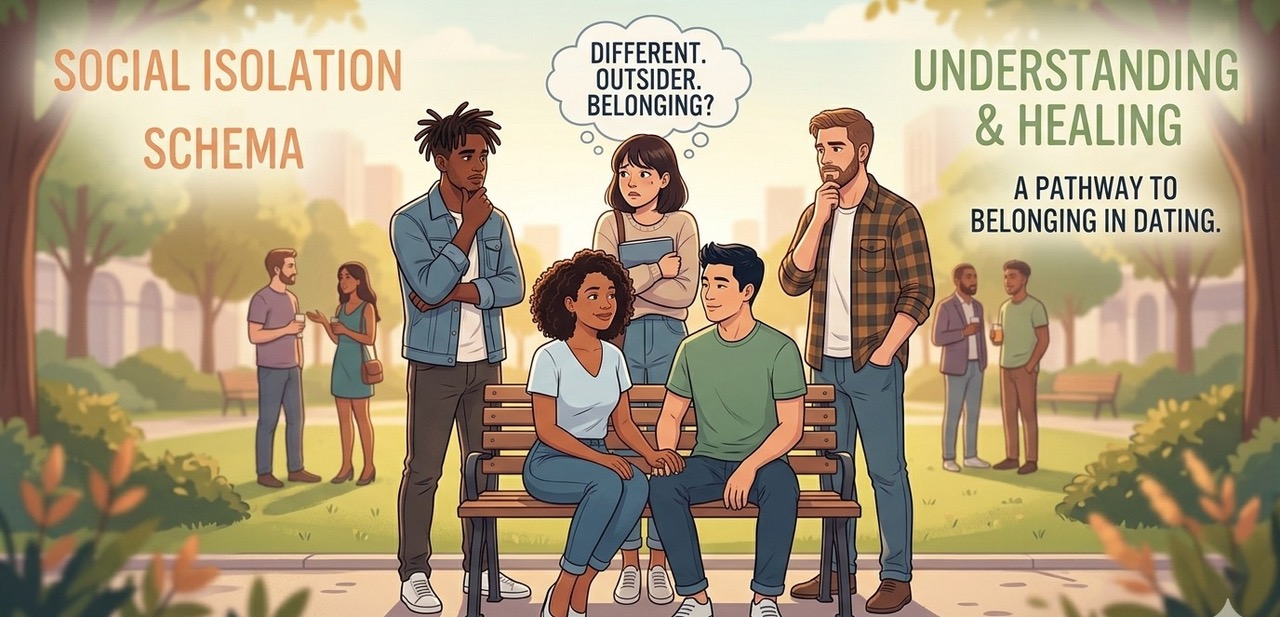

I have worked with many clients struggling with social anxiety disorder who also struggle with a social isolation schema in the context of dating. They feel fundamentally different, as if they don’t fit in with the rest of the world. Many worry they may never find a life partner because they feel awkward or strange, fearing their partner’s friends and family will eventually see them as “not relationship material”. This schema acts as a powerful lens, leading to overthinking, avoidance, and profound difficulty building lasting intimacy.
While many people feel unsure about dating at times, a social isolation schema is something deeper. It is an internal conviction that you don’t quite fit—that you’re fundamentally different from others in a way that makes connection harder. At its core, this pattern is driven by one belief:
“I’m different in a way that makes it hard to belong.”
This isn’t just a passing thought; it becomes a filter through which every dating experience is interpreted. Neutral moments feel meaningful, positive signals are discounted, and any sense of disconnection feels like confirmation of your “outsider” status. This pattern also fuels social anxiety, as you become increasingly focused on how you’re coming across and whether you’re being judged.

Understanding Early Maladaptive Schemas
Early maladaptive schemas are deeply ingrained cognitive and emotional patterns that develop in childhood or adolescence and repeat throughout adulthood. They are self-defeating and often resistant to change because they feel like truths about the self rather than just thoughts.
Social isolation falls into the “Disconnection and Rejection” domain. When this schema is triggered in vulnerable situations like dating, it activates the body’s threat response, fueling the hyper-vigilance and self-monitoring associated with social anxiety.
The Social Isolation Schema in the Dating World
If you have this schema, dating can feel like trying to enter a world you don’t quite belong in. You may want connection, yet feel fundamentally separate from the very people you want to connect with.
Because of this, you’re often not just dating—you’re watching yourself date, analyzing your performance in real-time. This self-monitoring is a core feature of social anxiety and makes it much harder to feel present or connected.
You might notice:
- The belief that others are more “normal,” confident, or naturally comfortable.
- The assumption that you come across as awkward, boring, or out of place.
- A feeling of disconnection even when a date is going objectively well.
How Does this Pattern Form?
This pattern usually starts early in life. You may have developed it if:
- You felt emotionally or temperamentally different in your family.
- You were criticized, rejected, or excluded by peers in school.
- Your family background (ethnicity, religion, or status) felt separate from your community.
The Trigger Cycle: From Schema to Social
Dating is a fast-track to activating this schema. When a date begins, your mind might jump to: “I don’t belong here”, or “They’re going to realize I’m strange”.
When these thoughts occur, your attention shifts inward. You start monitoring your tone of voice and posture. This inward focus is a hallmark of social anxiety; it pulls you out of the moment, making it much harder to connect naturally with the person in front of you.

How the Schema Sabotages Relationships
1. The “imposter” feeling: You feel like you’re playing a role. There’s a fear that if someone saw the real you, they wouldn’t connect. This prevents real intimacy.
2. Distorted compatibility: You might date fellow “outsiders” solely because it feels safe, or idolize socially successful partners, feeling like a guest in their life rather than an equal.
3. Misinterpreting social cues: Because you expect not to fit, you become hyper-aware of signs of exclusion (eg. inside jokes).
4. Meeting your partner’s friends and family: This is often the strongest trigger. You may feel like an outsider looking into their world, interpreting their shared history as signs that you don’t belong.
5. Self-sabotage: As a relationship deepens, the fear of ‘not fitting’ increases, leading you to pull away or end things prematurely.
How Cognitive-Behavioral Therapy and Schema Therapy Help
Because this pattern operates on both a surface level (anxiety) and a deeper level (beliefs), we address it from two angles.
Cognitive-behavioral therapy (CBT): helping you in the moment
CBT focuses primarily on what’s happening in real-time. It helps you notice and challenge automatic thoughts and underlying beliefs, shift your attention outward instead of monitoring yourself, and stay engaged even when uncomfortable.
Schema therapy: changing the deeper patterns
Schema therapy goes deeper. It helps you understand where the outsider feeling comes from and works with the emotional part of you that feels separate. It teaches you to stop surrendering to these beliefs and start experiencing genuine
How to Start Healing
- Recognize the pattern: Notice when the thought “I don’t fit” shows up. It’s a belief, not a fact.
- Check your assumptions: Is there real evidence I don’t fit, or is this my “outsider” lens?
- Value your uniqueness: What feels different to you is often what makes you interesting and engaging to others.
References:
Arntz A. (2012). Schema therapy for cluster C personality disorders. In The Wiley-Blackwell Handbook of Schema Therapy.
Baljé AE et al. (2024). Group schema therapy versus group cognitive behavioral therapy for social anxiety disorder: A randomized controlled trial. Journal of Anxiety Disorders, 98.
Cacioppo JT & Hawkley LC. (2009). Perceived social isolation and cognition. Trends in Cognitive Sciences, 13 (10).
About the author:
Laura Johnson, LMFT, LPCC, is a board member of the National Social Anxiety Center and the director of the Cognitive Behavior Therapy Center of Silicon Valley. She is the author of Social Anxiety for Dummies and is an Advanced Certified Schema Therapist.
[Paul DePompo, PsyD, ABPP, NSAC Blog Coordinator, NSAC Associate.]