


When social anxiety is causing you repeated problems, you unintentionally get caught up in vicious cycles of thoughts, feelings, and behaviors that often end up making you feel anxiety and shame, and hurt how you come across and perform.
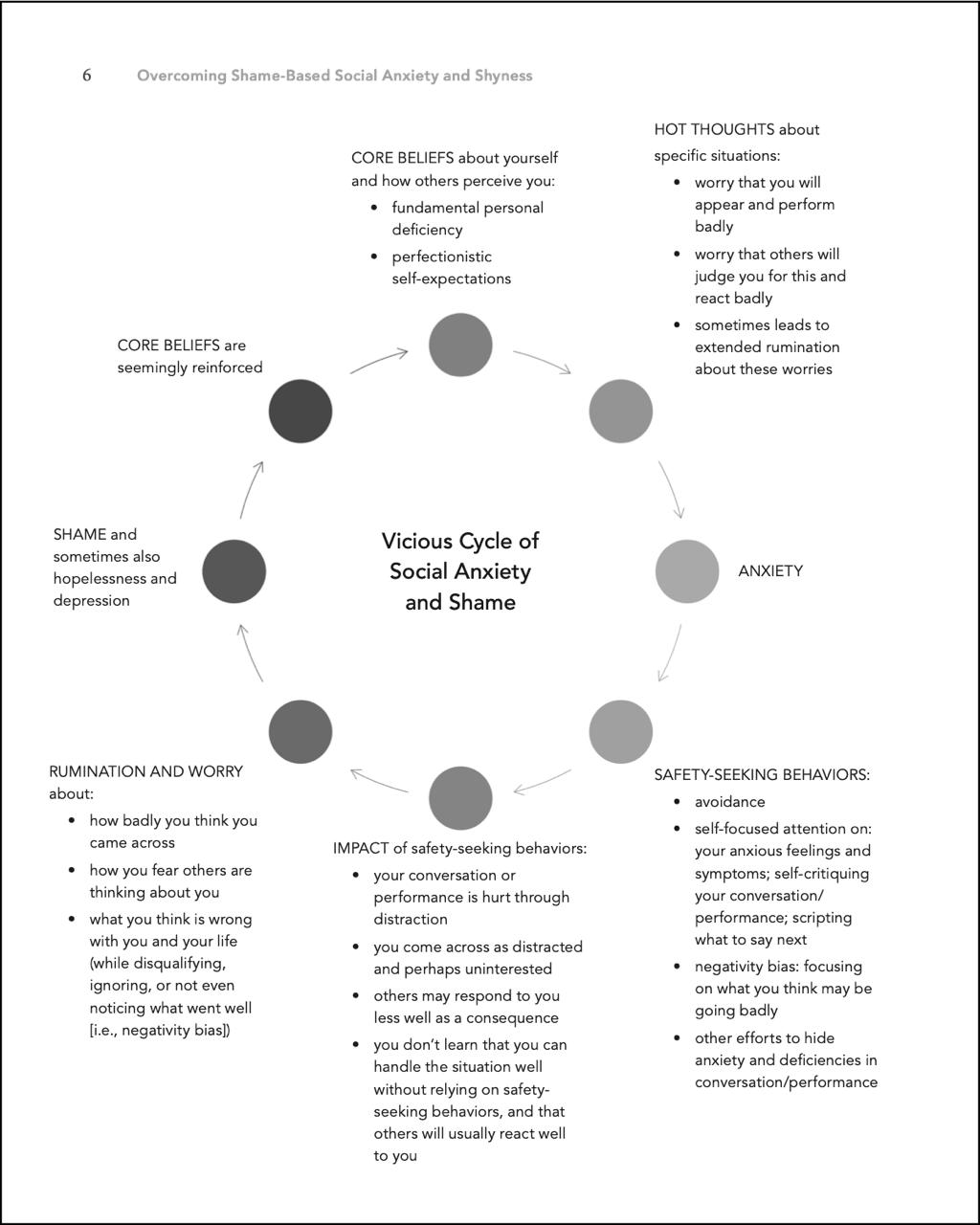
The experience of social anxiety involves a vicious cycle fueled by core beliefs of fundamental personal deficiency and perfectionistic self-expectations. These beliefs generate hot thoughts (automatic thoughts) about conversing or performing badly, and appearing anxious or foolish in situations where you fear your deficiencies may be exposed.
These thoughts generate much anxiety, leading you to rely on safety-seeking behaviors in an effort to avoid making a bad impression. Examples of safety-seeking behaviors include: avoidance; self-monitoring and self-critiquing performance and appearance; scripting what to say next; keeping attention off yourself; and trying to hide your anxiety. But these safety-seeking behaviors backfire and actually hurt how you come across, converse, or perform: an unintentional self-fulfilling prophesy.
Because of your negativity bias (ie. a safety-seeking behavior in which you mainly focus on what you think may be going badly during an interaction), you believe you made a much worse impression than you actually did, which leads you to engage in self-critical rumination and worry after the triggering situation and before the next one. This, in turn, causes you to feel shame and anxiety, and reinforces your core beliefs of personal deficiency and perfectionistic self-expectations.
This vicious cycle is illustrated in the following diagram:
Let’s take a close look at two common examples of social anxiety to see how this vicious cycle plays out.
Mingling with Strangers

Let’s say you’re invited to a party by a friendly coworker, Jason. You have a personal goal to make more friends, so you think that this party could be an opportunity to begin doing so. But you’re troubled by old core beliefs—seemingly supported by years of painful evidence—that you’re really bad at socializing and meeting new people; and if others see you appear anxious or screw up in the conversation, they’ll be turned off and think that you’re weird or uninteresting.
In the past, you’ve generally avoided social activities out of fear that your social deficiencies and anxiety would show, that others would react negatively to you, and that you would end up with feeling shame and depression. You’re very tempted to rely on your old safety-seeking behavior of avoidance this time, too. You spend a lot of time ruminating, worrying, and trying to figure out what to do. You consider telling Jason that you already have other plans that day. You think that Jason was just being nice in inviting you and doesn’t really care if you come.
You scold yourself with shame: “What’s the matter with me that I feel so anxious about going to a party?! Other people enjoy going to parties. Maybe this time will be different.” So you go.
After spending a lot of time worrying about what to wear, when to arrive, and whether you should come up with a last-minute excuse to not attend, you finally arrive at the party. With much anxiety, you quietly knock on the door and wait with mounting discomfort for what feels like a long time. You knock again, this time louder. Somebody answers the door, but it’s not someone you know. You manage to say that you’re here for Jason’s party, and that person lets you in but doesn’t introduce herself. You’re left standing just inside the door as you look around the large room and see that it’s crowded with people standing in small groups and actively chatting. You criticize yourself for not arriving earlier when there would have been fewer people. You’re trying to figure out what to do. You think about leaving, but you feel ashamed and criticize yourself for even thinking so.
You finally see Jason across the room, chatting and laughing away with people you don’t know. You can’t hear what they’re saying. You’re trying to decide what to do, but you’re troubled and frozen by anxious hot thoughts: “Should I go up to them and say hi, or would they think I’m intruding and being rude? Do others notice me standing alone so long, and are they thinking that I’m weird and unfriendly?” Then, to your surprise, Jason happens to turn a little. His eyes meet yours. He smiles and laughs. He turns back and continues laughing and chatting with his friends, who briefly glance your way, and then turn back.
You feel a surge of embarrassment. You have the hot thoughts that you’ve already made a terrible impression with Jason and his friends, who are probably saying negative things about you and even laughing at you. Your anxiety is increasing, and you’re thinking of just turning around and leaving, but feel too much shame for even considering that option. So you stay, take a deep breath, walk up to Jason, and timidly say hi to him and his friends.
They seem friendly enough. They try to make conversation with you, but you rely on your old safety-seeking behaviors of answering their questions in just a few words in order to get the attention off of yourself. You focus attention on your own anxious feelings and physical symptoms in a futile effort to control and hide them: your voice, which you think sounds horribly shaky with nervousness; your hands, which seem so jittery; and the warmth you feel in your face, which you imagine appears beet red. You also desperately try to script in your mind what to say next, and only come up with questions, again to keep the attention off of you. You criticize yourself for coming across so awkwardly. You end up just standing there quietly while Jason and his friends continue chatting, now ignoring you. Your safety-seeking behaviors backfire, making you appear uninterested and uninteresting to your conversational partners, who respond by saying very little to you. This results in a self-fulfilling prophecy which you perceive as confirmation of your core beliefs about fundamental personal deficiency.
At some point you excuse yourself to go to the bathroom, where you spend time ruminating in self- criticism and feeling shame. After a prolonged escape in the bathroom—where you start feeling anxiety that others will think you’re weird for being there so long—you finally return to the party, grab a drink, and engage in other safety-seeking behaviors of standing off by the side, quickly averting eye contact with people, and looking at your phone a lot in order to appear busy. Again, these safety-seeking behaviors backfire, and lead others to avoid you, thinking you’re unfriendly or uninterested, and thereby resulting in another self-fulfilling prophesy for you.
The few times somebody does come up to try to talk to you, you rely on your other safety-seeking behaviors: speaking very briefly, focusing on your anxiety symptoms, and trying to script what to say next…all of which backfire, hurting the conversation and how the other persons perceives and responds to you: another experience of self-fulfilling prophesy. Each conversation is just as awkward and brief as the previous one. Your negativity bias kicks in, making you unaware that at least one person seemed to enjoy talking with you, and may even have been flirting with you. But by looking away and speaking only briefly, you came across as uninterested.
You finally sneak out of the party—too anxious and ashamed to say goodbye to anyone—and go home. There, off and on for weeks, you ruminate about how badly you think came across, feeling engulfed in shame about yourself and despair about your future. Your negativity bias keeps you stuck in self-criticism while disqualifying or ignoring the positive aspects of your attending the party. At work, you avoid or minimize interaction with Jason as much as possible out of fear of facing a negative reaction from him.
Speaking to a Group

Let’s say you’re at a meeting at work. Because you have the core belief that you’re fundamentally deficient at conversing in groups, and that others will judge you as weird and incompetent if they see you screw up or appear anxious in any way, you rely on the safety-seeking behavior of sitting silently and just listening to others speak in order to keep attention off yourself.
But then someone asks you a question and your anxiety surges. You now engage in the safety-seeking behavior of speaking very briefly, even though you have much more you could say, because you hate the attention, which you assume to be critical. You focus on your anxious symptoms in the hope that you can hide them from the examining eyes of others, which only distracts you and intensifies your anxiety. When it’s your turn to present something, you focus on your notes or slides, reading them word for word rather than speaking freely, while avoiding looking at the audience. These safety-seeking behaviors backfire, hurting how you come across and what you say, resulting in a self-fulfilling prophesy which seemingly confirms your core beliefs of personal deficiency and perfectionistic expectations of your performance. Your negativity bias leads you to home in on someone who appears uninterested while not noticing others who look quite interested in what you’re saying. After the gathering, you ruminate in harsh self-criticism off and on for days, leaving you feeling deep shame, and setting yourself up to experience even more anxiety the next time you need to speak up in a group.
Breaking the Vicious Cycle

It doesn’t have to be this way! Through evidence-based cognitive-behavioral therapy (CBT), you can learn to break the vicious cycle and experience a positive, virtuous cycle instead.
Imagine that you go to the party or speak at the group gathering with the core belief that you have strengths and weaknesses like everyone else, and that you don’t have to appear or perform perfectly for people to enjoy talking with you and be interested in what you have to say. Instead of relying on your safety-seeking behaviors, you focus your attention externally and with curiosity on what people are saying in the moment, and on expressing what pops into your mind naturally, without scripting. Instead of allowing negativity bias to lead to ruminating in self-criticism afterward, you pat yourself on your back for the positive things you did and the positive experiences you had during this interaction. You accept as completely normal that not every interaction will go ideally and that not everyone will like you, seeing that as just an indication that everyone has different preferences, not that you are deficient. Instead of feeling shame, you feel pride, self-confidence, and hopefulness for the future. Instead of worrying how the next interaction will go, you look forward to it as an opportunity for enjoyment and to move your life forward.
You can achieve all this through your work in CBT, ideally with the guidance of a CBT therapist trained in helping people overcome their social anxiety problems, or by working with a good CBT for social anxiety self-help book.
For more information and a brief description of CBT for social anxiety strategies, see my earlier NSAC blog article: Shame—The Oft-Neglected Ingredient in Social Anxiety.
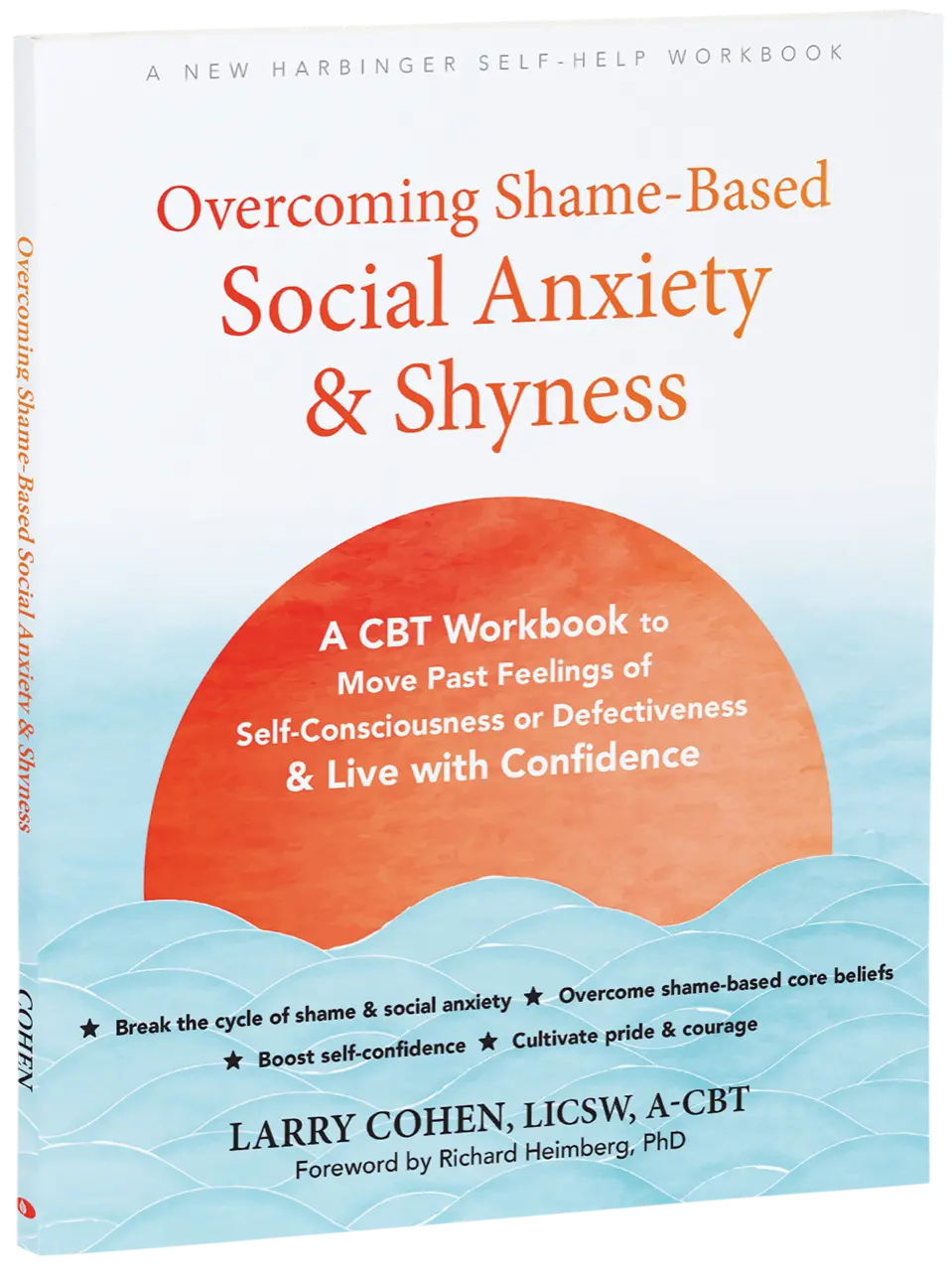 This article is adapted from chapter 1 of my book: Overcoming Shame-Based Social Anxiety and Shyness: A CBT Workbook. This self-help workbook provides a user-friendly, comprehensive guide to using evidence-based CBT strategies to help you identify and break your vicious cycles of social anxiety and shame, which you can use on your own, in your therapy sessions, or together with a friend or support group. Click here to view an Ask the Author interview with me about this book.
Use the links below to find a therapist trained in CBT for social anxiety.
References:
Mayo-Wilson, E., S. Dias, I. Mavranezouli, K. Kew, D. Clark, A. Ades, and S. Pilling. 2014. “Psychological and Pharmacological Interventions for Social Anxiety Disorder in Adults: A Systematic Review and Network Meta-analysis.” Lancet Psychiatry 1: 368–76.