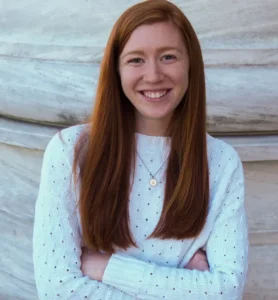
Allie is a fourth-year Clinical Psychology PhD candidate at Vanderbilt University studying the cognitive-behavioral underpinnings of anxiety under the mentorship of Dr. Bunmi Olatunji. Prior to her tenure at Vanderbilt, she completed her undergraduate studies in Human Development and Psychological Services at Northwestern University, where she researched the role of cognitive biases in psychosocial development in midlife under the mentorship of Dr. Regina Logan. Allie then served as a post-baccalaureate Research Assistant in Dr. Katherine Burdick’s Mood Disorders Research Program at Brigham and Women’s Hospital, Harvard Medical School, where she coordinated a multi-site study examining neurocognitive mechanisms of emotion dysregulation in mood disorders.
Since beginning graduate school, Allie has carved out a programmatic line of research centered on the role of cognitive mechanisms (e.g., attentional biases, cognitive control, repetitive negative thinking) in the etiology and maintenance of anxiety and related disorders. Her dissertation research, supported by the National Institute of Mental Health, has specifically focused on elucidating dysfunctions in the attentional system that contribute to social anxiety. Her research has adopted experimental, longitudinal, and cross-sectional designs, and examined outcomes across multiple levels of analysis (eg. behavioral, physiological, subjective report). Allie’s program of research ultimately aims to identify cognitive vulnerabilities with potent causal effects on clinical anxiety to inform novel treatment targets and approaches.
What is your area of research?
My research is focused on delineating the role of cognitive mechanisms in the maintenance of anxiety. Specifically, I am interested in clarifying the effects of attentional biases, cognitive control, and repetitive negative thinking on anxiety at multiple levels of analysis and in ecologically valid settings, ultimately with the aim of informing more precise etiological models and potent treatment targets. My dissertation research has primarily examined these questions within the context of social anxiety disorder (SAD) given the high prevalence, disease burden, and treatment limitations associated with SAD. The role of attention in social anxiety is a particularly interesting and challenging puzzle to solve given that SAD has been associated with both externally oriented (i.e., hypervigilance towards social threats) and internally oriented (i.e., excessive self-monitoring) attentional biases, making it unclear as to which pattern of attention is most pathogenic and accordingly important to target in treatment. Findings from my research thus far have suggested that excessive self-focused attention while socializing plays a salient role in the maintenance of social anxiety, in part by increasing acute anxiety and subsequent post-event processing (ie. rumination over past social events).
How do you stay informed about the current research?
I have three main channels that I use to stay informed about current research. First, I have set Google Scholar alerts for researchers and topics related to my interests so that I handily receive emails when new literature is published that might be relevant to my work. Second, I am fortunate to get exposed to a wider breadth of research through my professional network, whether that be through weekly article discussions during lab meetings, attending department talks and colloquia, or direct sharing of interesting work from my peers, research mentors, and clinical supervisors. Third, I love to attend conferences to learn about current/developing research in our field and have the opportunity to engage directly with the researchers involved in the work. Most importantly, I have learned over the years how important it is to proactively make time in my schedule for reading and discussing research, as it is very easy to let that fall by the wayside when juggling several other competing priorities and deadlines.
Is there a mentor that has shaped your development as a researcher?
I have an incredible amount of gratitude for my PhD advisor, Dr. Bunmi Olatunji, for serving as such a phenomenal research mentor to me throughout my graduate training. I chose to pursue my PhD at Vanderbilt under Dr. Olatunji’s mentorship due to his expertise in the multilevel examination of cognitive-behavioral theory for anxiety disorders. What I did not necessarily expect was to also receive such impactful scaffolded training in how to become an independent clinical scientist. Since beginning my graduate studies, Dr. Olatunji has empowered me to establish my own line of research examining the effects of cognitive vulnerabilities on the maintenance of anxiety. Dr. Olatunji has trusted me to learn by doing, and has supported me to pursue my unique interests, all while providing invaluable expertise in experimental psychopathology and the cognitive-behavioral underpinnings of anxiety disorders that has helped me refine my research ideas and approaches. Dr. Olatunji has also modeled for me how to approach research challenges as learning opportunities, and how to be persistent in the face of setbacks and failures. Thanks to Dr. Olatunji, I feel prepared to take the next steps towards building out my program of research independently following my graduate training.
What are your professional goals post-graduation?
After graduation, I hope to pursue a post-doctoral fellowship that will allow me to broaden my research skills and continue developing my independent line of work. In particular, I would love to obtain more specialized training in ambulatory assessments and eye tracking methods, and/or to gain experience with translating findings from my mechanistic work into interventions that can be tested in the context of randomized clinical trials. Ultimately, I hope to take this line of work to an academic setting, where I would be thrilled to lead a productive and innovative research laboratory as a professor.
What advice do you have for students seeking to conduct research on social anxiety in the future?
My biggest piece of advice would be to spend time with patients. Getting a better understanding of individuals’ first-hand experiences with social anxiety is invaluable for bringing concepts to life and generating new ideas about what processes are playing a functional role in the maintenance of their symptoms and accordingly might be effectively targeted in treatment.
I would also advise students to read broadly to help think outside the box when it comes to their own research on social anxiety disorder. For example, you might be inspired by ideas from the RDoC or HiTOP literatures in terms of how you conceptualize the nature of social anxiety. You might also discover methods or concepts from other clinical populations that might be applicable for advancing our understanding of social anxiety disorder. Making a concerted effort to step out of research silos is crucial for developing innovative ideas that will ultimately move the field forward.